The 7 Stages of Dementia, Explained — With What Each One Actually Looks Like at Home
A plain-language walk through the Reisberg Global Deterioration Scale — the seven-stage framework clinicians use to describe Alzheimer's progression. Each stage is described with what it actually looks like in daily life at home.
Thank you! Your submission has been received!
Oops! Something went wrong while submitting the form.
The 7 Stages of Dementia, Explained — With What Each One Actually Looks Like at Home
If you have just learned that your parent has dementia, one of the first things you'll want to know is what comes next. The honest answer is that no two cases are identical — but there is a recognized framework that clinicians use to describe the progression of Alzheimer's disease, and it gives families a usable map.
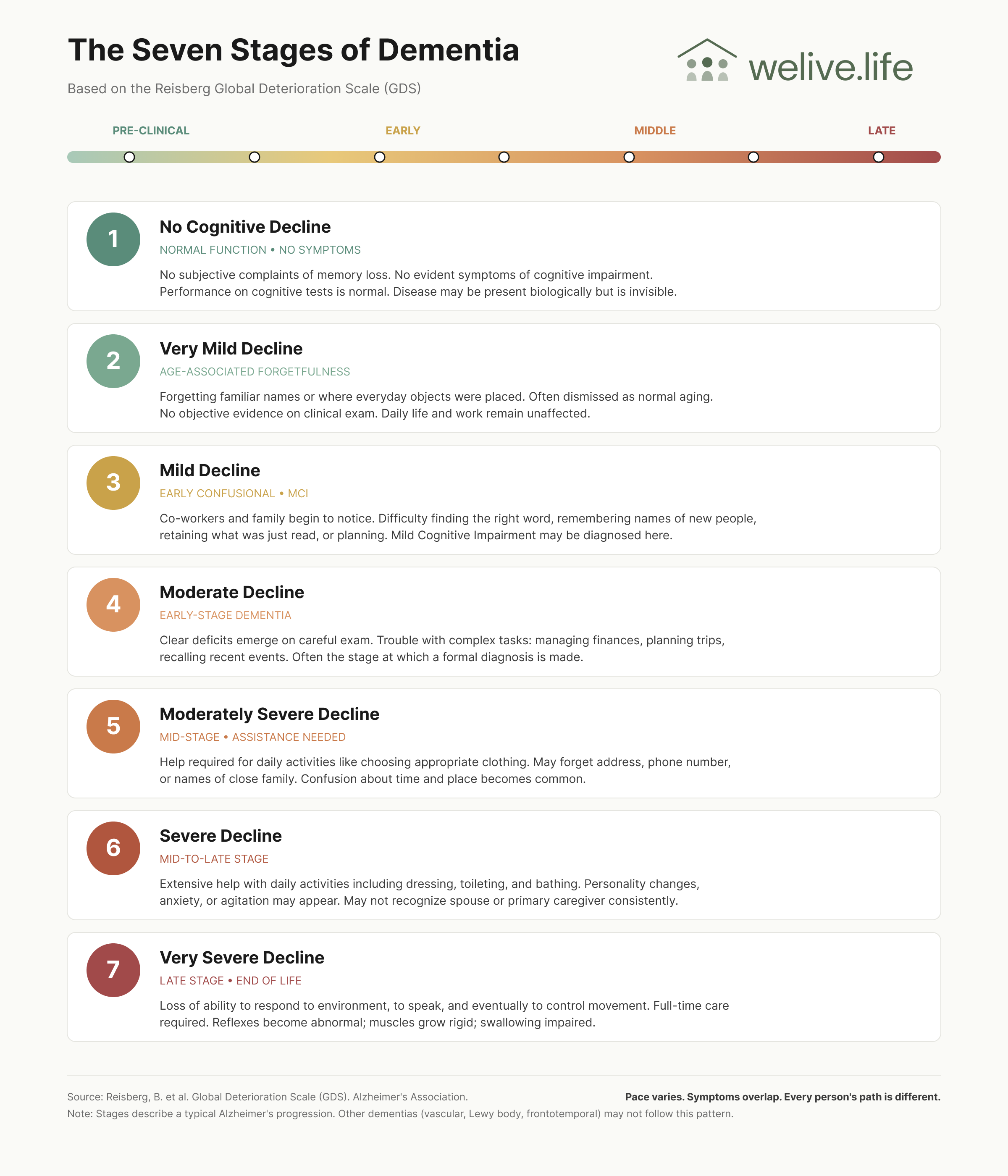
It's called the Global Deterioration Scale, or GDS, developed by Dr. Barry Reisberg at NYU in 1982 and still in use today.1 It divides cognitive decline into seven stages, from "no impairment" through "very severe decline." This post walks through each stage in plain language, with descriptions of what it actually looks like in a person's daily life — drawn from clinical sources and from what families describe in screening calls.
A few things to keep in mind before we start.
First, the GDS was developed for Alzheimer's disease specifically. Other dementias — vascular, Lewy body, frontotemporal — don't always follow the same pattern, because they begin in different parts of the brain and damage different functions first. Second, progression timelines vary enormously. Some people remain in the early stages for many years; others move through them faster. Third, the boundaries between stages are not crisp — people drift between them, especially in the middle of the disease.
With those caveats, here are the seven stages.
Stage 1: No cognitive decline
This is the baseline — a person with normal cognitive function, no memory complaints, and no observable difficulties. Most adults are in Stage 1 for most of their lives. There are no symptoms because there is no clinical disease.
It's worth noting that the underlying biology of Alzheimer's may begin to develop years or even decades before any symptoms appear.2 The amyloid plaques and tau tangles that define the disease can be detected in the brain through PET imaging or cerebrospinal fluid biomarkers before a person ever notices a problem. But by clinical definition, Stage 1 is symptom-free.
Stage 2: Very mild cognitive decline
The person experiences subjective memory complaints — they feel like their memory isn't quite what it used to be. They may forget familiar names occasionally or misplace objects more often. These changes are not detectable on a standard cognitive test, and family and friends typically don't notice anything unusual.
Stage 2 is often indistinguishable from normal aging. Most people in their 60s and 70s have some version of these complaints. Whether it represents the very earliest phase of a disease or simply normal cognitive aging is, in most cases, impossible to tell at the time.
What you might hear at home: "I can't remember names like I used to." "Where did I put my keys?" "My mind isn't as sharp as it was."
Stage 3: Mild cognitive decline (early-stage)
This is the stage where subtle but real difficulties begin to appear, and where family members and close colleagues may start to notice. The person may have trouble finding the right word, struggle to remember names of people they've recently met, lose objects of value more often, or have difficulty with planning and organization at work.
Cognitive testing can sometimes detect deficits at this stage, particularly on memory tests. This corresponds clinically to what's called mild cognitive impairment, or MCI. Not everyone with MCI progresses to dementia — but a meaningful proportion do, particularly those with the amnestic subtype.2
Many of the new amyloid-targeting medications, like lecanemab and donanemab, are approved specifically for this stage and the earliest dementia stage that follows it. This is also the window in which lifestyle interventions appear to have the greatest impact.
What you might hear at home: missed appointments. Repeating the same question within an hour. A new pattern of getting lost on unfamiliar drives. Subtle withdrawal from social settings that have become difficult.
Stage 4 is the first stage that meets the clinical threshold for dementia. The deficits are clear on examination and on testing. The person has trouble with complex tasks: managing finances, planning a dinner for guests, traveling to unfamiliar places, recalling recent events. Personality may begin to flatten — withdrawal, denial, mild anxiety.
Importantly, the person still recognizes familiar people, knows where they are, and can perform basic self-care. The deficits are real but the person still has substantial independent function.
This is often the stage at which a formal diagnosis is made — because by Stage 4, the symptoms are no longer easy to explain away as stress, normal aging, or "just getting older."
What this looks like at home: a parent stops paying bills. A parent gets confused making a recipe she has known for forty years. A parent insists they remember a recent conversation that they clearly do not. A parent withdraws from book club, cards, the volunteer board.
Stage 5: Moderately severe cognitive decline (moderate dementia)
Stage 5 is the point at which a person can no longer live independently without assistance.1 They may be unable to recall important details about themselves — current address, phone number, the name of a high school they attended. They may have trouble with day, date, or season. They typically still know their own name and the names of immediate family.
Self-care begins to require help. Choosing weather-appropriate clothing becomes difficult. The person may wear the same outfit several days in a row, or layer inappropriately. Medication management is no longer safe to leave to the person alone.
Stage 5 is often the stage at which families have their hardest conversations: about whether a parent can continue living alone, about whether assisted living is needed, about who in the family will take on the coordination role. It is also the stage where Medicare's GUIDE program and other care navigation supports become most valuable, because the daily-management burden has crossed a threshold that families typically cannot carry alone.
What this looks like at home: a parent forgets the names of grandchildren but knows their own children. A parent calls at 2am unsure where they are. A parent forgets to eat or eats the same meal three times. A parent cannot consistently manage medications.
Stage 6: Severe cognitive decline (moderately severe dementia)
Stage 6 is sometimes called middle-stage dementia, and it is often the longest stage in terms of duration. The person increasingly forgets the names of close family members, including spouses and adult children, though they may retain a sense of who is familiar versus a stranger. They need substantial help with bathing, dressing, and toileting.
Behavioral and psychological symptoms often appear or worsen at this stage. These include sundowning — increased agitation in the late afternoon and evening — anxiety, suspiciousness, hallucinations or delusions, and changes in sleep patterns. Wandering becomes a real safety concern. Personality changes can be pronounced.
This is typically the stage at which families weigh memory care placement, hire 24/7 in-home help, or fully reorganize the household around the parent's care. It is also the stage where caregiver burnout becomes acute, and where respite care — including the respite benefit covered by Medicare's GUIDE program — becomes essential rather than optional.
What this looks like at home: incontinence. Need for help with all basic activities of daily living. Parent calling their adult child by their own deceased mother's name. Repeated nighttime confusion. Episodes of agitation that don't respond to gentle redirection.
Stage 7: Very severe cognitive decline (late-stage dementia)
In Stage 7, verbal abilities are severely limited. The person may have only a few words or be unable to speak at all. They lose the ability to walk, sit up unassisted, or hold their head up. Swallowing becomes difficult, which raises the risk of aspiration and pneumonia. Care is fully hands-on at every level.
This is the stage at which hospice services typically become appropriate. Hospice in dementia is about comfort, dignity, and family support — not curative treatment. Many families find that hospice care, when chosen at the right time, transforms the final months from a medical crisis into a more peaceful arc.
The duration of Stage 7 varies, but most people spend a relatively short period of time in this stage compared to the earlier ones — often months rather than years.
What this means for planning
The seven stages are useful not because they predict exactly what will happen, but because they give families a sense of arc. The early stages last longer than people expect. The middle stages are where the daily care burden is heaviest. The late stages are shorter but require the deepest reorientation of the family's life.
A few things worth doing early, before they become urgent:
Get a healthcare proxy and durable power of attorney signed while the person has capacity. By Stage 4 or 5, this becomes legally complicated.
Have the conversation about long-term wishes — including hospice — while the person can participate.
Identify which family member will be the primary point of contact for medical decisions, and document it.
Look into Medicare's GUIDE program early. Eligibility is broader than most families realize, and the navigator support is most valuable when started in Stage 4 or 5, not Stage 7.
Knowing the map doesn't make the journey easier. But it does mean fewer surprises, and that is worth a great deal when so much else is unpredictable.
— King
References
Reisberg B, Ferris SH, de Leon MJ, Crook T. "The Global Deterioration Scale for assessment of primary degenerative dementia." American Journal of Psychiatry 1982;139(9):1136-9. PubMed
Alzheimer's Association. "Stages of Alzheimer's." 2024. alz.org
National Institute on Aging. "How Alzheimer's Disease Is Diagnosed." NIA, 2024. nia.nih.gov
.png)